陣列的定義陣列是一個連續的記憶體空間,每個元素的大小、型態皆相同,在 assembly 中定義陣列的方式很簡單,以下用個範例來說明:
segment .data
    ;宣告長度為 10 的陣列,每個元素大小為 double word,並分別初始化元素的值為 1, 2, 3, ....., 10
    a1  dd  1, 2, 3, 4, 5, 6, 7, 8, 9, 10

    ;宣告長度為 10 的陣列,每個元素大小為 word,初始化所有元素的值為 0
    a2  dw  0, 0, 0, 0, 0, 0, 0, 0, 0, 0

    ;與上一個宣告相同,但使用 TIMES 關鍵字表示重複指令的次數
    a3  times   10  dw  0

    ;宣告長度為 200 的陣列,每個元素大小為 word,每一個元素的值為 1
    a4  times   200 dw  1

segment .bss
    ;宣告長度為 10 的陣列,每個元素大小為 double word,未初始化
    a5  resd    10

    ;宣告長度為 200 的陣列,每個元素大小為 word,未初始化
    a6  resw    200
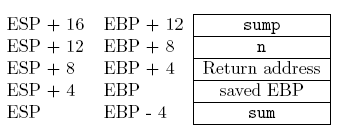
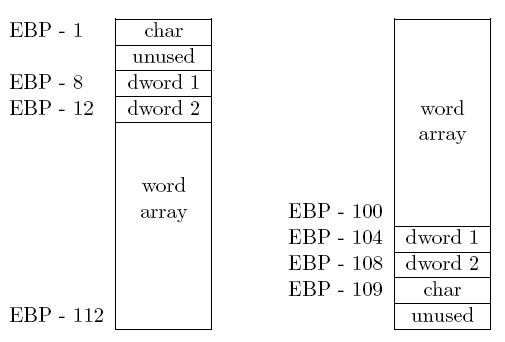
而若要在在 stack 將陣列定義為 local 變數呢? 假設需要的空間有 1 個 char、2 個 double word、50 個 word 元素的陣列,一共需要 1 * 1 + 2 * 4 + 50 * 2 = 109 個 bytes 的空間,從之前介紹過的程式來看,有兩種方法可以達成,一個是透過 [ESP - 109] 的方式來保留記憶體空間,另一個則是用
ENTER 指令來保留空間,以下為保留記憶體空間後的 stack 圖示:
 陣列的存取
在 assembly 中存取陣列的元素值,並非像 C 或其他高階語言一樣,使用中括號(
[])加索引的方式,而是必須要清楚指定 memory address(以 byte 為單位),以下用幾個範例來說明:
;定義兩個陣列,每個元素的大小分別為 byte 與 word
byteArray   db  5, 4, 3, 2, 1
wordArray   dw  5, 4, 3, 2, 1

;存取 byte 陣列
mov     al, [byteArray]         ;AL = byteArray[0]
mov     al, [byteArray + 1]     ;AL = byteArray[1]
mov     [byteArray + 3], al     ;byteArray[3] = AL

;存取 word 陣列
mov     ax, [wordArray]         ;AX = wordArray[0]
mov     ax, [wordArray + 2]     ;AX = wordArray[1] 注意! 這邊 + 2 bytes 即是 + 1 word
mov     [wordArray + 6], ax     ;wordArray[3] = AX
mov     ax, [wordArray + 1]     ;這是錯誤的用法,因為元素大小為 word(2 bytes)
以下介紹如何將陣列的值進行加總:
    mov     ebx, byteArray      ;將 byteArray 的初始位址存到 EBX 中
    mov     dx, 0       ;總和存於 DX 中
    mov     ah, 0       ;為了確保 AX = AL,因此要清空 AH
    mov     ecx, 0      ;loop 的次數以 ECX 中的值為主,每次遞減
lp:
    mov     al, [ebx]   ;AL = *EBX
    add     dx, ax      ;add 指令兩端 operand 的大小必須相同
    inc     ebx         ;移至陣列的下一個元素
    loop lp
接著用範例說明陣列的操作方式:
// ==================== array1c.c ====================
#include <stdio.h>

int asm_main(void);
void dump_line(void);

int main() {
    int ret_status;
    ret_status = asm_main();
    return ret_status;
}   //end main

void dump_line() {
    int ch;
    while((ch = getchar()) != EOF && ch != 'n')
        ;
}   //end dump_line


; ==================== array1.asm ====================
%define ARRAY_SIZE 100
%define NEW_LINE 10

segment .data
    FirstMsg        db  "First 10 elements of array", 0
    Prompt          db  "Enter index of element to display: ", 0
    SecondMsg       db  "Element %d is %d", NEW_LINE, 0
    ThirdMsg        db  "Elements 20 through 29 of array", 0
    InputFormat     db  "%d", 0

segment .bss
    array       resd    ARRAY_SIZE

segment .text
    extern  puts, printf, scanf, dump_line
    global  asm_main
asm_main:
    enter       4, 0    ;預留空間給 local 變數用,長度為 double word [EBP - 4]
    push        ebx     ;保留 EBX 的值,先存入 stack 中
    push        esi     ;保留 ESI 的值,先存入 stack 中

    ;初始化陣列值為 100, 99, 98, 97, .....
    mov     ecx, ARRAY_SIZE
    mov     ebx, array
init_loop:
    mov     [ebx], ecx
    add     ebx, 4
    loop    init_loop

    push    dword   FirstMsg    ;印出 FirstMsg
    call    puts
    pop     ecx

    push    dword   10
    push    dword   array
    call    print_array        ;印出陣列中的前十個元素
    add     esp, 8              ;使用 C function 後必須回復原本 ESP 指向的位址(使用 2 個 stack 空間)

Prompt_loop:
    push    dword   Prompt
    call    printf
    pop     ecx                 ;將 Prompt 的 memory address pop 到 ECX 中(沒意義,只是將其從 stack 中移除)

    lea     eax, [ebp - 4]      ;EAX = local 變數的位址
    push    eax
    push    dword   InputFormat
    call    scanf
    add     esp, 8              ;使用 C function 後必須回復原本 ESP 指向的位址(使用 2 個 stack 空間)
    cmp     eax, 1              ;EAX = scanf 的 return value
    je      InputOK

    call    dump_line
    jmp     Prompt_loop

InputOK:
    mov     esi, [ebp - 4]
    push    dword   [array + 4 * esi]
    push    esi
    push    dword   SecondMsg
    call    printf
    add     esp, 12             ;使用 C function 後必須回復原本 ESP 指向的位址(使用 3 個 stack 空間)

    push    dword   ThirdMsg
    call    puts
    pop     ecx                 ;將 ThirdMsg 的 memory address pop 到 ECX 中(沒意義,只是將其從 stack 中移除)

    push    dword   10
    push    dword   array + 20 * 4
    call    print_array
    add     esp, 8              ;呼叫 function 後必須回復原本 ESP 指向的位址(使用 2 個 stack 空間)

    pop     esi                 ;還原 ESI 的值
    pop     ebx                 ;還原 EBX 的值
    mov     eax, 0              ;回到 C 程式中
    leave
    ret

; routine : _print_array
; C 程式
; void print_array(const int *a, int n);
; 參數:
;   (1) a - 指向陣列的 pointer  [EBP + 8]
;   (2) n - 要印出的元素數量    [EBP + 12]
segment .data
    OutputFormat    db  "%-5d %5d", NEW_LINE, 0

segment .text
    global  print_array
print_array:
    enter   0, 0
    push    esi     ;保留 ESI 的值,先存入 stack 中
    push    ebx     ;保留 EBX 的值,先存入 stack 中

    xor     esi, esi    ;ESI = 0
    mov     ecx, [EBP + 12]     ;迴圈次數
    mov     ebx, [ebp + 8]      ;EBX = 陣列位址
print_loop:
    push    ecx     ;printf 可能會改變 ECX 中的值,因此先存入 stack 中作保留

    ;呼叫 C 語言中的 printf,使用的 stack 中的資料作為參數
    ;分別為(1)OutputFormat (2)ESI (3)陣列值
    push    dword   [ebx + 4 * esi]
    push    esi
    push    dword   OutputFormat
    call    printf
    add     esp, 12     ;使用 C function 後必須回復原本 ESP 指向的位址(使用 3 個 stack 空間)

    inc     esi         ;index++
    pop     ecx         ;還原 ECX
    loop    print_loop

    pop     ebx     ;還原 EBX 的值
    pop     esi     ;還原 ESI 的值
    leave
    ret
Array/String Instructions在 80x86 的 CPU 中,設計了許多用來處理 array 的指令,這些指令稱為 string instruction,他們利用 index register(ESI、EDI) 做為索引之用,並搭配 FLAGS register 中的 direction flag(DF) 來判斷索引為遞增或遞減,其中有兩個指令可用來設定 direction flag:
- CLD(clears the direction flag):將 DF 設定為 0,為遞增
- STD(sets the direction flag):將 DF 設定為 1,為遞減
Reading & writing memory首先先說明讀寫記憶體內容所使用的指令:
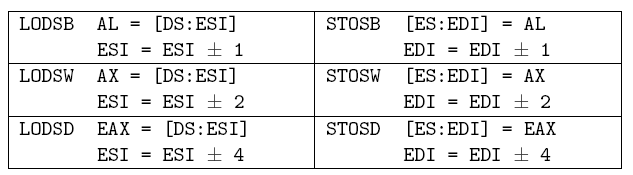
左邊的部分是 read memory,右邊則是 write memory;而從上面這個表中,有三個部分是需要注意的:
- 實際資料存放的位置
LOASx 的部分,是存放在 data segment 中;STOSx 的部分則是存放在 extra segment 中 - 所使用到的 index register
LOASx 使用的是 ESI(source index);STOSx 則是使用 EDI(destination index) - 每次迴圈,index register 所遞增的值
根據不同的資料長度,分別為 1(byte)、2(word)、4(double word)
此外,還可以注意到所使用的 segment 為 data segment(左邊) 與 extra segment(右邊),以下用一個簡單範例來介紹:
segment .data
    ary1    dd  1, 2, 3, 4, 5, 6, 7, 8, 9, 10

segment .bss
    ary2    resd    10

segment .text
    cld     ;將 direction flag 設定為 0,讓 index register 的動作為遞增
    mov     esi, ary1   ;將 ary1 的 memory address 放到 ESI
    mov     edi, ary2   ;將 ary2 的 memory address 放到 EDI
    mov     ecx, 10     ;為了執行迴圈 10 次

lp:
    ;將每個在 ary1 中的元素複製到 ary2 中
    lodsd   ;load single double word
    stosd   ;store single double word
    loop    lp
而上述的效果,還可以用 MOVSx 指令來達成,而 MOVSx 指令的使用可以參考下表:
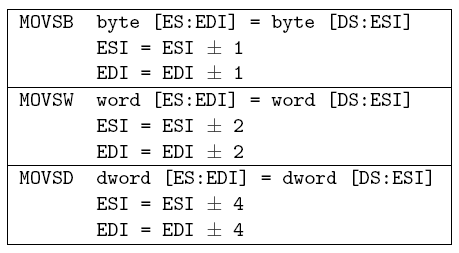
上述的 mov 所處理的資料大小是不同的,因此使用上就必須注意一下囉! 在上一個範例中,LODSD 與 STOSD 的結合,其實用 MOVSD 就可以達到相同效果囉!!!
REP 指令講完 loop 的寫法後,一定要提到
REP 指令,其實這個指令就是 repeat 的意思,也是以 ECX 中的值作為重複次數的依據,而且可以用很簡單的語法就可以完成,以上面程式的最後三行為例(lp label 後的三行),可以改成以下這一行:
rep movsd ;MOVSD 的效果可以參考上表
以下用一段範例程式碼將陣列所有元素初始化為 0:
segment .bss
    ary     resd    10

segment .text
    cld     ;讓 index register 為遞增
    mov     edi, ary
    mov     ecx, 10
    xor     eax, eax    ;下一個指令會用到 EAX
    rep     stosd       ;[EDI] = EAX (使用 extra segment,EDI += 4)
Comparison 相關指令接著這邊介紹的是用來進行比對的指令,這些指令用來比較 register 與 memory 的值,以下用一張圖來介紹有哪些指令可用:
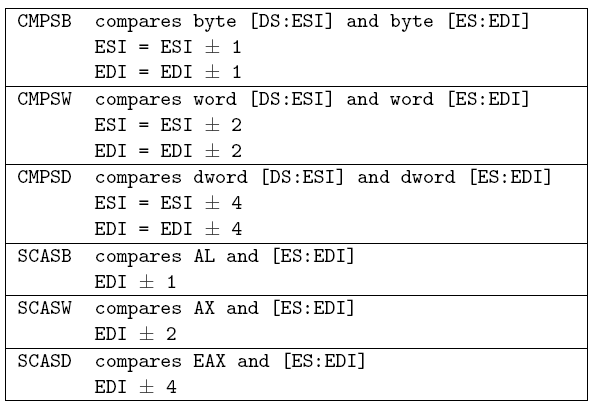
以上這些指令,跟 CMP 相同,也是會修改 FLAGS register 中的值做為程式判斷的依據,以下用一段簡單的程式碼來說明使用方式:
segment .bss
    ary     resd    100

segment .text
    cld     ;index register 為遞增
    mov     edi, ary
    mov     ecx, 100
    mov     eax, 12     ;為了找尋陣列中有無元素值為 12

lp:
    scasd   ;比對 EAX 與 [ES:EDI] 的值
    je      found   ;有尋找到,跳至 found label
    loop    lp
    ;=====================
    ;找不到的時候,所要執行的程式碼放這
    ;=====================

found:
    sub     edi, 4  ;確定目前 EDI 所儲存的為指向 12 元素的 pointer
    ;=====================
    ;找到以後,所要執行的程式碼放這
    ;=====================
REPx 指令REPx 指令與 REP 是類似的,都是作為 repeat 指令之用,以下先用張圖來說明有哪些相關指令:

而 REPx 通常用來與 comparison 指令進行搭配,而若是有比對相同,程式並不會因此停止執行,index register 會持續遞增,而 ECX 則是會持續遞減,直到條件達到(Z flag=1/0 或 ECX=0)為止。
以下用一段比對 memory block 的程式來說明 REPx 的使用方式:
segment .text
    cld
    mov     esi, block1 ;第一個 memory block 的 address
    mov     edi, block2 ;第二個 memory block 的 address
    mov     ecx, size
    repe    cmpsb       ;持續的比對每一個 byte,直到 Z=1 或是 ECX=0
    je      equal

    ;=====================
    ;比對不同,所要執行的程式碼置於此處
    ;=====================

    jmp     onward      ;必須跳離,不然會執行到 equal Label 去

equal:
    ;=====================
    ;比對相同,所要執行的程式碼置於此處
    ;=====================

onward:
範例說明最後用一個較為完整的範例來說明這些指令的使用:
memory.asmglobal asm_copy, asm_find, asm_strlen, asm_strcpy
segment .text
; function: asm_copy
; 用途:複製 memory block
; C functin 定義 :
; void asm_copy(void *dest, const void *src, unsigned sz);
; 參數說明 :
; (1) dest - 指向目的地位址的 pointer
; (2) sec - 指向來源端位址的 pointer
; (3) sz - 要複製的 byte 數量
%define dest [ebp + 8]
%define src [ebp + 12]
%define sz [ebp + 16]
asm_copy:
enter 0, 0
push esi ;保留 ESI 與 EDI 的值(先存入 stack)
push edi
mov esi, src
mov edi, dest
mov ecx, sz
cld ;指定 index register 為遞增 (direction flag = 0)
rep movsb ;[ES:EDI] = [DS:ESI] (ESI += 4 、 EDI += 4)
pop edi ;還原 ESI 與 EDI 的值
pop esi
leave
ret
; function: asm_find
; 用途:在記憶體中尋找指定的 byte
; C functin 定義 :
; void *asm_find(const void *src, char target, unsigned sz);
; 參數說明 :
; (1) src - 指向來源端位址的 pointer
; (2) target - 所要尋找的 byte 值
; (3) sz - 所要尋找的 memory block 大小
; 回傳值說明 :
; 若找到指定的值,回傳指定該值的 pointer;若無,回傳 null
;
; 注意:尋找的是 byte,但因為使用到 stack,因此要把他當作 double word 來處理(使用 lower 8 bits)
%define src [ebp + 8]
%define target [ebp + 12]
%define sz [ebp + 16]
asm_find:
enter 0, 0
push edi
mov eax, target
mov edi, src
mov ecx, sz
cld
repne scasb ; scan memory block 的值,直到 ECX=0 或是 [ES:EDI]=AL
je found_it
mov eax, 0 ;未發現,回傳 null pointer
jmp short quit
found_it:
mov eax, edi ;由 C 呼叫 assembly function 時,回傳值必須存在 EAX 中(因為長度為 double word)
dec eax ;讓 pointer 指向正確的位址
quit:
pop edi
leave
ret
; function: asm_strlen
; 用途:回傳字串的長度
; C functin 定義 :
; unsigned asm_find(const char *);
; 參數說明 :
; (1) src - 指向字串的 pointer
; 回傳值說明 :
; 字串長度(會存入 EAX 中)
%define src [ebp + 8]
asm_strlen:
enter 0, 0
push edi
mov edi, src ;將 string pointer 放到 EDI 中
mov ecx, 0FFFFFFFFh ;設定 ECX 為最大
xor al, al ;AL=0
cld
repnz scasb ;尋找字串結尾(\0)
mov eax, 0FFFFFFFEh
sub eax, ecx ;length = 0FFFFFFFEh - ecx
pop edi
leave
ret
; function: asm_strcpy
; 用途:複製字串
; C functin 定義 :
; void *asm_strcpy(char *dest, const char *src);
; 參數說明 :
; (1) dest - 指向複製來源字串的 pointer
; (2) src - 指向複製目的地字串的 pointer
%define desc [ebp + 8]
%define src [ebp + 12]
asm_strcpy:
enter 0, 0
push esi
push edi
mov edi, dest
mov esi, src
cld
cpy_loop:
lodsb ;將字元讀取到 AL 中,並遞增 ESI 的值
stosb ;將字元從 AL 中讀取出來,並遞增 EDI 的值
or al, al ;設定 condition flags
jnz cpy_loop ;尚未遇到結束字元(\0),繼續執行
pop edi
pop esi
leave
ret
memex.c#include <stdio.h>
#define STR_SIZE 30
void asm_copy(void *, const void *, unsigned);
void * asm_find(const void *, char target, unsigned);
unsigned asm_strlen(const char *);
void asm_strcpy(char *, const char *);
int main(void) {
char st1[STR_SIZE] = "test string";
char st2[STR_SIZE];
char *st;
char ch;
asm_copy(st2, st1, STR_SIZE); //呼叫 assembly function
printf("%s\n", st2);
printf("Enter a char: ");
scanf("%c%*[^\n]", &ch);
st = asm_find(st2, ch, STR_SIZE); //呼叫 assembly function
if(st)
printf("Found it: %s\n", st);
else
printf("Not Found\n");
st1[0] = 0;
printf("Enter string: ");
scanf("%s", st1);
printf("len = %u\n", asm_strlen(st1)); //呼叫 assembly function
asm_strcpy(st2, st1); //呼叫 assembly function
printf("%s\n", st2);
return 0;
} //end main
編譯、執行指令shell> nasm -f elf memory.asm ; gcc -o memex memex.c memory.o ; ./memex